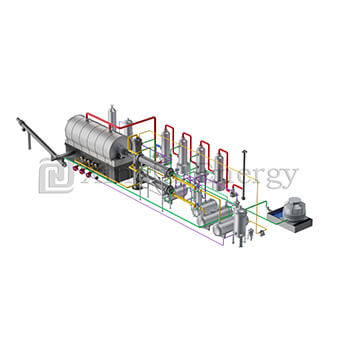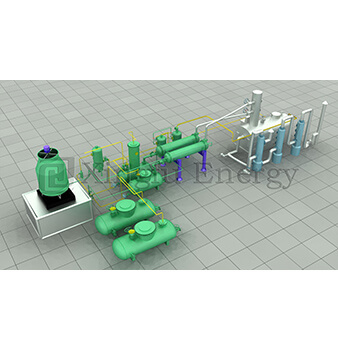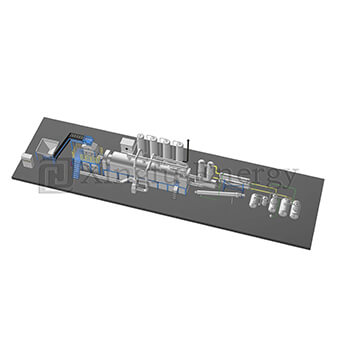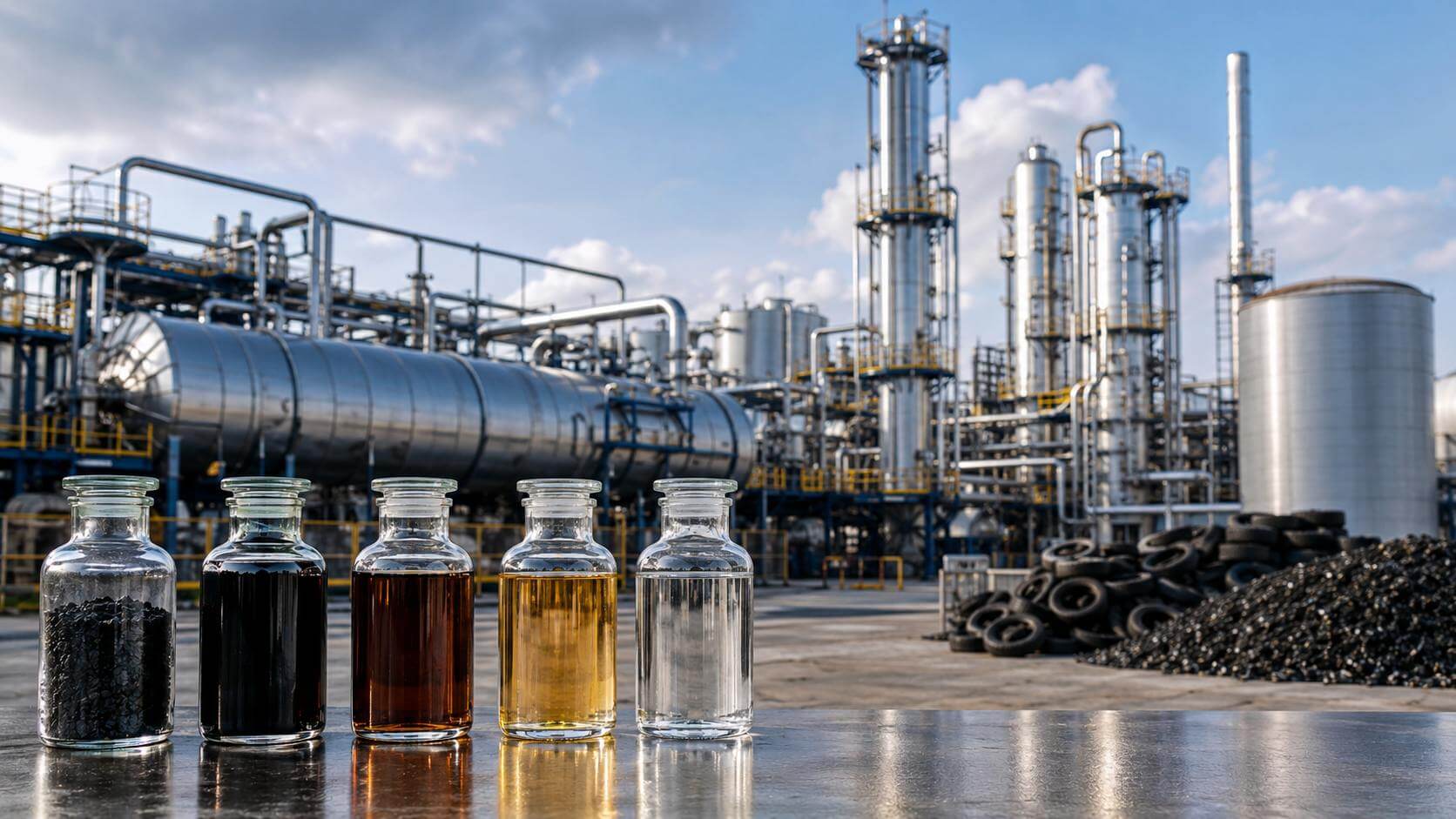
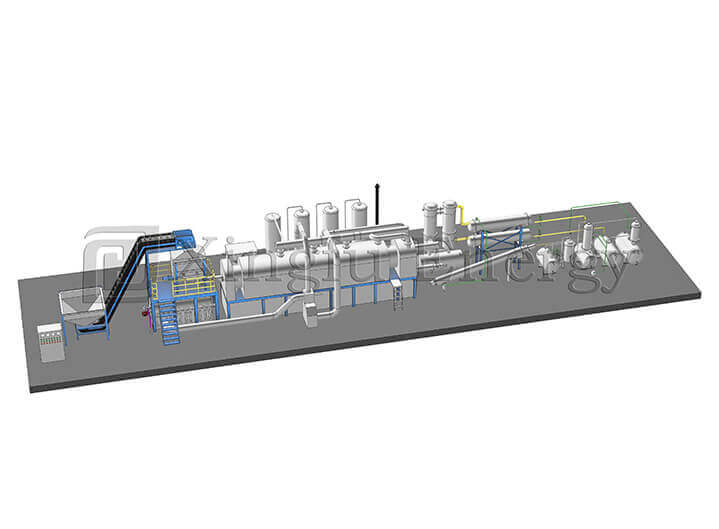
Continuing to upgrade the process of waste tyres and plastics recycling into valuable liquid fuels, the waste pyrolysis plant can process the waste materials in a fully continuous manner to produce pyrolysis oil. The crude pyrolysis oil or pyrolysis oil obtained from waste tyre or plastic recycling is a mixture of various hydrocarbons and aromatic compounds, and small amounts of water and sediments etc other by products. To determine whether this crude oil needs distillation prior to sales on the market, factors such as the oil composition, markets for the oil and financial returns need to be taken into account.
Before we can assess the necessity of a distillation process, a preliminary analysis of pyrolysis oil is required. This includes an overview of pyrolysis oil and its production in a fully continuous process.
Pyrolysis oil originates from the thermal decomposition of waste tyres or plastics in an oxygen-free environment. The absence of oxygen prevents combustion, allowing long-chain polymers to break down into smaller hydrocarbon molecules. The resulting liquid contains paraffins, olefins, aromatics, and oxygenated compounds along with impurities such as residual carbon particles, moisture, and inorganic matter. Its viscosity and calorific value vary depending on feedstock type—tyres generally yield heavier fractions than plastics—and process temperature control. These characteristics influence its potential use as fuel or chemical feedstock.
A fully continuous plant operates through uninterrupted feeding of raw materials and simultaneous discharge of by-products such as char and gas. This design ensures stable reactor conditions and higher throughput compared to batch systems. Automated temperature control maintains consistent heating rates that optimize oil yield while minimizing secondary cracking reactions. Because manual handling is limited, contamination risks are reduced, resulting in more uniform product quality suitable for industrial-scale operations.
After having produced the crude pyrolysis oil, operators have to make a decision about distillation etc. in view of market and official requirements.
The Distillation Process is a method of purification whereby a crude mixture is separated and split into a number of different fractions including lighter (gasoline type), middle (diesel type) and heavier fractions. The separation of a crude mixture into these fractions can help improve combustion efficiency. The process of fractionation also reduces the level of sulfur, water and other contaminants in the crude which can produce smoke or cause corrosion when burned. The purified fractions have greater stability when in storage or transit as the mixture of reactive compounds in the crude has been controlled by heating at the correct temperature.
Industrial buyers prefer the distilled pyrolysis oil due to its predictable behavior with respect to applications of pyrolysis oil in boilers or blending with diesel oil or other fuel in order to take advantage of higher calorific value. The crude oil from other sources are of low quality and thus the products are confined to very low grade heating applications. Thus, the industrial buyers pay higher prices for the products that have been refined to have standardized specifications for viscosity, flash point and other important parameters as provided by the fuel suppliers to meet the required performance criteria.
There are considerable technical problems associated with the distillation choice – problems of process design, of amount of energy required and of cost.
Fractional distillation columns separate components according to their volatility differences. Precise temperature control is essential; overheating may lead to thermal degradation or polymerization of valuable light fractions. Efficient condensation systems are also required to handle vapors with diverse compositions while maintaining recovery efficiency across multiple stages.
Crude oil can be refined and sold as such, to increase energy consumption. However, this would require significant investment in auxiliary equipment, such as boilers, condensers and pumps, which would not generate sufficient extra margin to be of interest. As a result, such additional value would have to be generated by increasing the sales price of the products produced from the refined crude oil. The cost/benefit of the additional refining step needs to be analyzed for the producer, based on the local price of electricity or fuel, the anticipated sales volume, and the plant operation at full capacity or not.
Refining a crude increases its quality metrics but not all markets can use a fully refined product.
The crude pyrolysis oil can be used directly as fuel in a furnace that is used in a cement kiln, a steel mill or a brick factory after some filtration to remove solids. The oil can also be used as a feedstock for further processing by hydrocracking or by catalytic reforming to make motor fuels and chemical feedstocks.
The direct sale of our fuel will be contingent upon the local environmental rules that govern the emissions that are released by the burning of fuel. There are places where they restrict the use of high sulfur and high ash content fuels because of air pollution. Potential buyers may also ask to see the laboratory test reports for the various parameters including density and flash point in order to verify the content of the fuel prior to entering into a purchase agreement.
Economic evaluation of refining investment within selected business models to verify returns.
The distilled pyrolysis oil is sold at premium price as it fulfills stricter criteria for use as fuel in terms of purity and flammability. Also the gaseous by-products which are split off during the distillation process can be completely reused for heating the plant. This is done by recycling the gaseous by-products in the heating system of the plant. This leads to an increase in the efficiency of the use of resources and at the same time to a decrease of the operational costs.
To capitalize on sales to regional markets producers have to tailor their production strategy to the buyer’s needs. Regional customers who require a boiler fuel cheaply may be supplied with crude oil, on the other hand a highly refined diesel substitute for consumption in other markets world-wide or even for re-export may require refining. Partnerships with downstream refineries or distributors, which allow for joint use of the logistics, can boost the producers’ return.
Qingdao Xingfu Energy is a professional manufacturer specializing in fully continuous waste tyre (plastic) pyrolysis plants designed for sustainable resource recovery through advanced thermal conversion technology. The company provides comprehensive technical support including customized engineering solutions tailored to feedstock characteristics and capacity targets. Installation guidance ensures correct setup while operator training programs promote efficient plant operation under real-world conditions. After-sales services encompass ongoing technical consultation, spare parts supply chains, and performance optimization assistance available globally—making Qingdao Xingfu Energy a trusted partner for enterprises investing in circular economy solutions.
The question remains if pyrolysis oil from a fully continuous pyrolysis plant should or not be distilled before it is put on the market. This decision will depend on several issues: the markets which the producer wants to serve with his oil, the environmental issues that have to be solved and last but not least the issue of value addition and costs versus potential extra revenue. Crude oil can be sold directly to industrial users of oil who can make use of it despite variable quality. However, after distillation the oil will have increased in purity substantially, thus being suitable for a larger number of customers on the market. The producer has to make a strategic decision on how he wants to do business with the oil he produced. His decision will be based on the issue of economic feasibility, allowing him to compete successfully on markets that are changing rapidly and aim at sustainability.
Yes. Continued processing at constant temperatures produces a constant quality product, though residues might require subsequent processing to meet specific product specifications.
The crude pyrolysis oil is a very heavy oil with high content of moisture and some solid particles. It is not suitable for clean combustion use. The distilled fractions are much lighter and thus suitable for use in engines or industrial burners, due to their high combustion efficiency.
After delivery Qingdao Xingfu Energy is available for post-delivery services, including commissioning and operator training to achieve best possible operation. Remote servicing via computer is also available 24/7 as well as scheduled maintenance advice and a full range of spare parts to ensure continued trouble-free operation. Servicing of plants installed by Qingdao Xingfu Energy is available worldwide.
 Address: 30th Floor, Building 3, Excellence Darongcheng, Shibei District, Qingdao City, Shandong Province
 Call us now:+86-13791972057
 Email:[email protected]


QINGDAO XINGFU ENERGY EQUIPMENT CO.,LTD