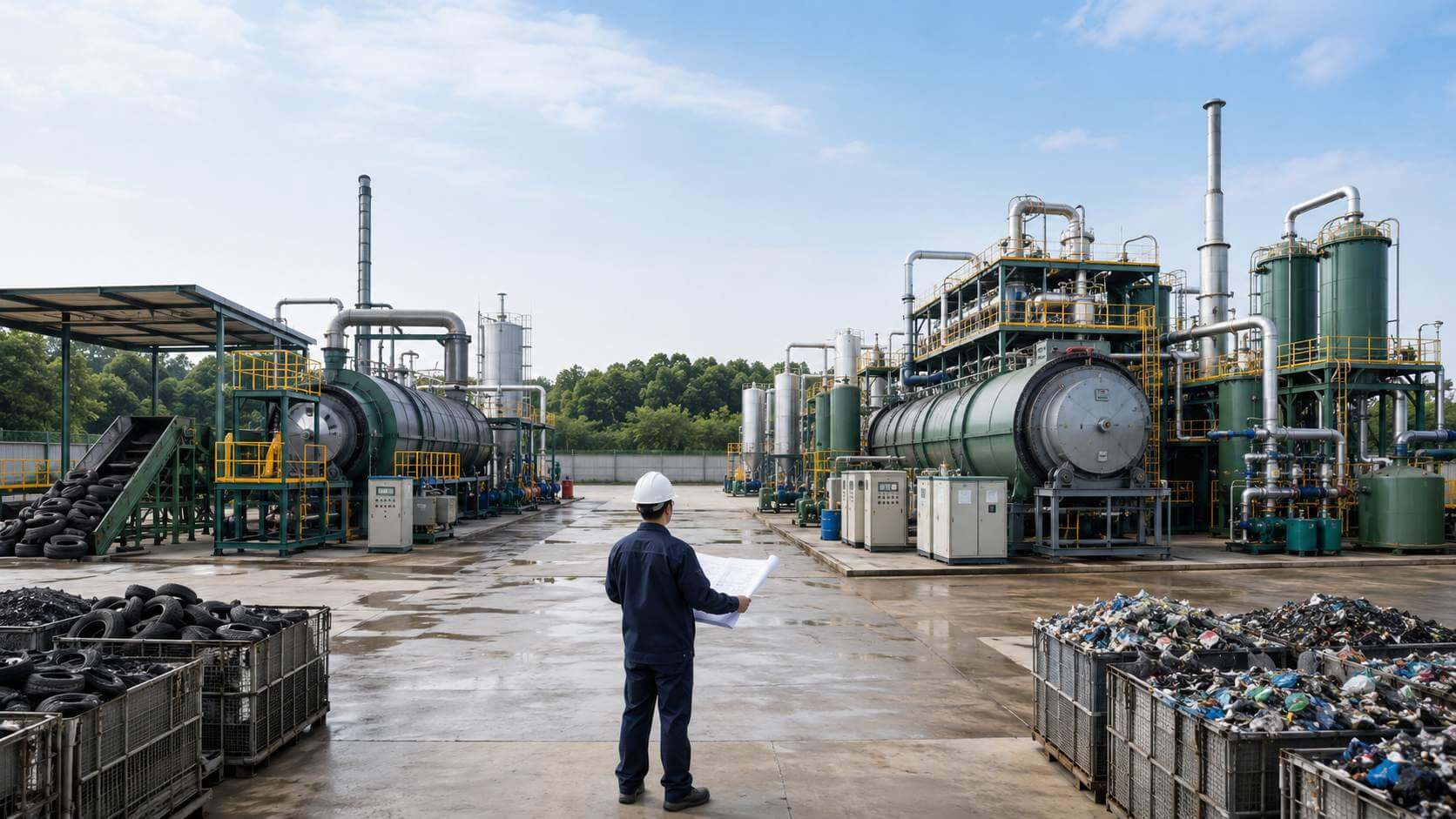
Using waste tyres and plastics to produce fuel oil, carbon black and steel wire in semi-continuous pyrolysis processes is a crucial method to combat pollution by turning waste into capital. When choosing a suitable capacity for such a plant it is essential to reach the optimal combination of efficiency, costs and return on investment. Among the many variations of industrial plants there are two most common ones: 10T and 20T semi-continuous pyrolysis plants, both differing in terms of production capacity and material supply.
While both throughput capacities describe how much a milling system is able to process, there are significant differences between them. These differences are reflected not only in the machinery used but also in terms of energy required and logistics.
Our 10T semi continuous waste tyre/plastic pyrolysis plant is able to process 10tons of raw material for each batch. Our 20T semi continuous pyrolysis plant is able to process 20tons of raw material for each batch. This higher throughput of a 20T plant means there is potential to make more oil per day, however the amount of oil that can be produced will still depend on the quality of the feedstock. In order to run a 20T plant efficiently the operator will need to have a reliable supply of waste tires or plastics, and be able to feed the material to the plant on a regular basis. For operators running their plant on a continuous basis, the feedstock logistics are as important as the performance of the reactor in terms of maintaining productivity.
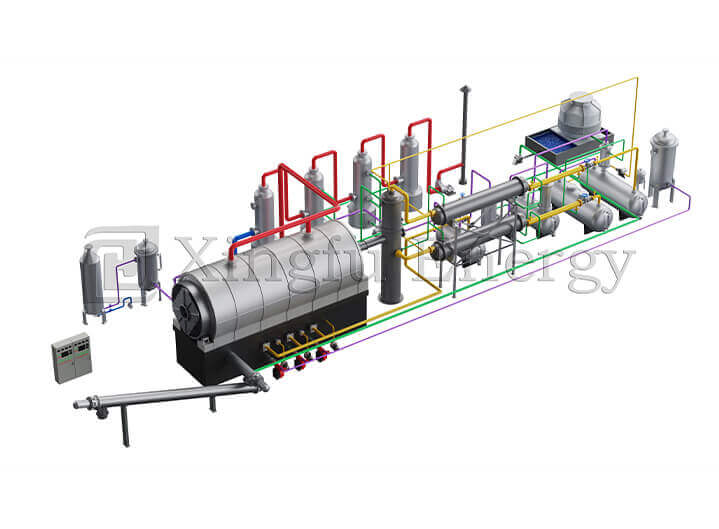
A 20T unit is typically bigger than a smaller unit and has a larger reactor vessel and better heat distribution. The condenser and heater units are of bigger capacity to handle a greater volume of gas. The heater unit may even have better burners, such as those with variable combustion, to improve combustion efficiency. Larger units have better thermal balance and therefore better efficiency through better heat recovery. However, they require more space for installation and a stronger foundation to support the greater weight of the equipment. Also, although they may require less frequent maintenance, the parts are bigger and more complex so that when they do require servicing, it can take longer.
The capacity scaling of pyrolysis systems has direct implications for the energy required to run them and how costs can be managed.
As noted above when comparing energy input in terms of kilowatt hours per ton of processed feedstock larger processing units generally have better thermal performance. This is primarily down to better building insulation and better heat exchange surfaces within the reactor section. For a semi-continuous processing unit such as our 20T pyrolysis plant it is able to make better use of residual gases from previous batches for preheat, thus keeping external fuel usage down. This results in less fuel being used per ton of feedstock processed than by using a smaller processing unit.
Key to assessing operational costs are the levels of manpower required, and the degree of complexity involved with maintenance. As mentioned earlier, a 10T plant operating as a smaller facility will demand more work from its laborers in terms of the number of loading’s and the time spent between each cycle. On the flip side, a 20T plant is highly suited for large scale production due to its ability to provide a high degree of automation. This in turn greatly reduces the need for manual intervention in key areas and therefore, the associated costs, when spread across a greater volume of production, will create economies of scale for the fixed costs. Other factors that have a bearing on maintenance costs are the ease of sourcing of alternative spare parts, and how often a facility would be expected to be down for repair. Although larger and more complex reactors, such as the 20T version, may cost more to repair on an individual basis to repair, this is generally balanced out by the longer periods between required maintenance. In this case a cost-per-ton assessment would suggest the larger 20T plant is the best option when operated at close to full capacity.
Beyond initial investment, the choice between these two capacities requires examination of many operational variables.
Reliable access to sufficient waste tyres or plastic feedstock is fundamental for sustainable operation. A region with limited collection infrastructure may struggle to support continuous feeding of a 20T unit, leading to underutilization. Seasonal fluctuations in waste generation or transportation delays can further affect utilization rates; hence smaller plants may offer better flexibility in such conditions.
Market dynamics play a significant role in assessing the appropriate plant size to invest in. Given strong local market demand for pyrolysis oil or recovered carbon black (rCB) from local industries, larger capacity units can generate higher returns on investment and thus are considered appropriate to invest in. In markets where the market is still developing or lack of export markets, a 10T capacity facility is an optimal size to grow rapidly without exposing excessive capital.
Capital expenditure of auxiliary equipment, such as condensers, gas cleaning units, and automation, increases in a non-proportional manner to the main reactor with capacity. The investment can be judged on expected payback period, based on current product price, feedstock cost, energy cost and plant operating efficiency. Typically both capacities will pay back in the region of 1 to 3 years, depending on market.
Before deciding on products to buy for a plant, the site-specific factors will have determined a number of feasible plant configurations.
The 20T version of the system is semi-continuous and will require more space than the 10T version, in addition to larger reactors, longer cooling lines, storage tanks, and auxilliary facilities. Sufficient and stable infrastructure such as a power supply, water for cooling, and fuel supply are needed to run such a system efficiently.
Larger systems will generally fall under more environmental restrictions due to their higher emission potential. These systems will need advanced flue gas cleaning equipment such as a scrubber or a complete purification system with a catalyst. In addition, the permitting process for larger systems can take longer in different regions due to more detailed environmental impact assessments by local authorities.
Qingdao Xingfu Energy are a manufacturer of semi continuous waste tyre(plastic) pyrolysis plants which are exported to projects all around the world. By incorporating the latest automation technology into our design, our Waste Tyre Processing Plants offer maximum safety by minimum man hours during the continuous processing phase. Our skilled and experienced engineers, have engineered the most efficient thermal processing in the reactor, by employing innovative heat recovery to minimize the quantity of fuel required to achieve high temperatures. Our processing plants are built to meet or exceed the strict environmental regulations from around the world and are designed to be installed in almost any location, to suit local circumstances. Qingdao Xingfu Energy offer full technical support from the customer, from the initial project analysis and design stage through to plant commissioning, and then on-going after-sales service to ensure long-term trouble-free operation. We offer a full maintenance service, and operator training.
To choose between a 10t per cycle semi-continuous pyrolysis plant or 20t per cycle semi-continuous pyrolysis plant, there are many considerations that have to be analyzed and balanced. Some of the considerations are amount of waste feedstock available on a regular basis, size of market that the plant is trying to service, amount of investment that is available, state of plant site, and local government rules and regulations that govern waste to energy plant construction and operation. A thorough analysis will lead to maximum efficiency with minimum capital expenditure. Qingdao Xingfu Energy pyrolysis plant supplier will guide you to choose the suitable model to ensure long term profit of waste recycling business.
The 20T production line offers higher output per production cycle allowing for better economies of scale, especially when sufficient amounts of the required feedstock are available. Automation scope and required changes are comparable to the 10T model.
Modular designs are created to allow incremental expansion. However, foundational structures, such as the utilities layout and the emission control systems, must be designed and built during the initial construction phase in order to allow for efficient scaling.
The payback period for Pyrolysis Plants varies between 1 to 3 Years based upon geographics and variables such as cost of raw materials, energy prices, sales realization of various end products produced from pyrolysis process and plant’s operating efficiency handled by operator.
 Address: 30th Floor, Building 3, Excellence Darongcheng, Shibei District, Qingdao City, Shandong Province
 Call us now:+86-13791972057
 Email:[email protected]


QINGDAO XINGFU ENERGY EQUIPMENT CO.,LTD