Starting up a pyrolysis plant costs a bunch right away. No question about that. But the real test comes from the bills that hit every single month. For anyone looking at a 10-ton-per-day batch unit that handles waste tires or plastics, electricity and payroll usually rank as the biggest regular hits. This article breaks those costs down clearly. We pull from actual equipment specs, mix in some common industry figures, and show exactly how the numbers stack up. By the time you finish reading, you should feel comfortable putting together a realistic monthly budget. That way the plant keeps running smoothly and your profits don’t disappear.
Lots of people fixate on the initial purchase price. That makes sense. It’s a big number. But after installation, the steady expenses arrive without fail. Electricity powers the fans, pumps, conveyors, and control systems. Workers handle loading, temperature checks, and output collection. Combined, these two items frequently make up 20 to 40 percent of all monthly operating costs. Location and local rates play a huge role.
Ignore them and problems show up quickly. A facility in Southeast Asia learned this the hard way. They lowballed the power draw at first. Extra cash vanished until they improved syngas reuse. Tiny adjustments like that can save serious money over twelve months.
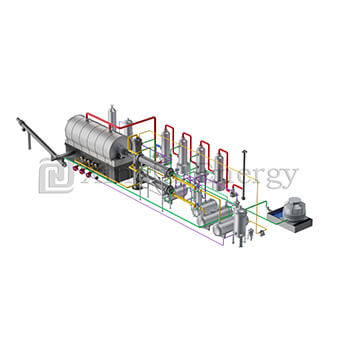
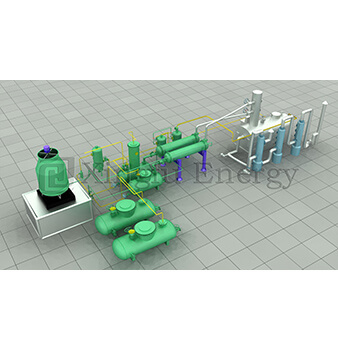
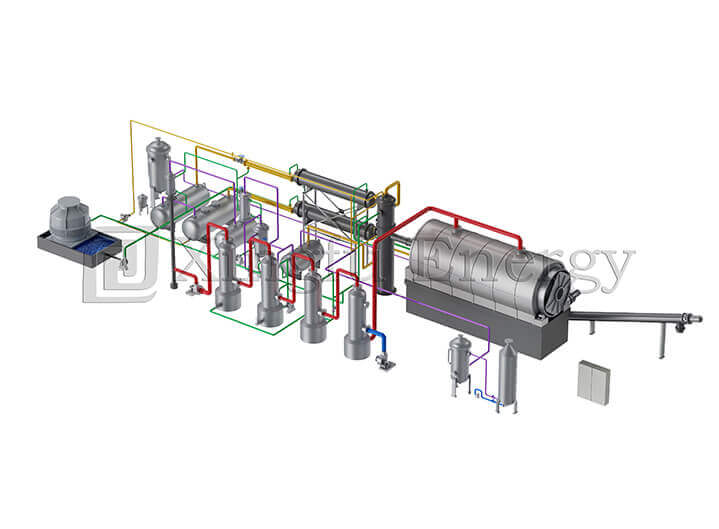
We’re looking at a typical batch-style machine, such as the XFLJ-10. It processes 10 tons of whole tires or mixed plastics each day. Tires bigger than 1200 mm go in whole. No extra shredding needed. That already saves time and money on preparation.
Here are the main figures:
The plant completes one batch per day. Load in the morning. Let it run. Discharge the following day. Most operators find that rhythm easy to manage.
Electricity isn’t always the largest bill. Heating fuel often takes that spot. Still, you can’t overlook the power draw. The full 65 kW rating covers the reactor motors, condensers, blowers, slag extractors, and dashboard controls.
When everything runs—pumps pushing oil, fans moving gas, auto-discharge working—it averages roughly 30 kW per hour. Over a 22-hour working cycle, that adds up to about 660 kWh per batch.
Take a real example. At ten cents per kilowatt-hour (a typical industrial rate in many U.S. areas), daily electricity costs around $66. Push the rate to fifteen cents in pricier spots like parts of California, and it jumps to $99. Run twenty-five days a month, and the monthly total lands between $1,650 and $2,475.
Industry numbers line up with this. Batch plants around 10 tons usually consume 300 to 500 kWh per full batch when syngas helps with heating. Our estimate falls right in that range.
Here’s a simple monthly power breakdown table (based on twenty-five working days):
| Electricity Rate | Daily kWh | Daily Cost | Monthly Cost |
| $0.08/kWh | 660 | $52.80 | $1,320 |
| $0.10/kWh | 660 | $66.00 | $1,650 |
| $0.12/kWh | 660 | $79.20 | $1,980 |
| $0.15/kWh | 660 | $99.00 | $2,475 |
Syngas reuse cuts external fuel demand after the initial heat-up. Electricity for auxiliary systems stays fairly constant.
Batch plants stay pretty hands-on. Continuous models need less attention. Here you typically need three to four operators per shift. One person watches the control screen. Another handles loading and unloading. The rest check safety, collect oil, and manage carbon black plus steel wire.
Shifts often last eight to twelve hours. Many plants run two shifts with some overlap for safety during discharge.
Pay differs a lot by area. In the U.S. Midwest or South, skilled operators might earn $20 to $30 per hour with benefits included. Average $25 an hour for three people on one shift (plus a bit of overtime), and daily labor costs roughly $600 to $800. Monthly total easily reaches $15,000 to $20,000.
In lower-cost regions like parts of Asia, the same staffing might run $5,000 to $8,000 per month. An operator I talked to in Indonesia said his four-person crew cost less than $6,000 monthly. Training took effort, though. Consistent yields didn’t happen overnight.
Ways to keep labor costs in check:
Power and labor don’t stand alone. Fuel use starts at about 200 kg per batch. Once syngas kicks in, external fuel drops sharply. Startup diesel might cost $0.50 per kg. That’s small compared to the savings from recycled gas.
Maintenance adds another layer. Expect $1,000 to $2,000 monthly for parts, oil changes, and routine checks. Water stays low thanks to the circulating system. Almost no fresh water gets used.
Feedstock preparation stays simple. Whole tires go straight in. That keeps extra costs down.
Qingdao Xingfu Energy has earned a strong reputation. They supply industrial boilers, pressure vessels, and pyrolysis systems for waste tires and plastics. Based in Qingdao, China since 2010, the company handles design all the way through installation. They hold CE and ISO certifications along with pressure vessel approvals. Equipment has shipped to more than thirty countries. Their batch plants emphasize dependable performance, solid safety features like pulse dust collection, and easy day-to-day operation. That suits operators who watch every penny closely.
When you add everything together, a 10T/D batch pyrolysis plant keeps power and labor expenses under control if you plan carefully. Figure on $1,500 to $2,500 monthly for electricity and $10,000 to $20,000 for payroll. Those amounts depend heavily on local rates and staffing choices. In most places, the figures beat landfill tipping fees. Add revenue from pyrolysis oil, carbon black, and recovered steel wire, and the picture improves fast. Keep the plant running steadily. Reuse syngas wisely. Train the team properly. The costs become predictable. Profits have room to grow.
A normal 10-ton batch unit uses close to 660 kWh per day. That assumes 30 kW average draw across a full cycle. At standard industrial rates, daily power costs fall between $50 and $100.
Three to four operators per shift handle most setups. One shift usually covers the daily batch with extra hands during discharge. In the U.S., monthly labor often runs $15,000 to $20,000. Costs drop lower in other parts of the world.
Batch models like the 10T/D use less steady electricity. They typically consume 300 to 700 kWh per batch since they run one cycle a day. Continuous plants operate around the clock and can reach 1,500 to 2,000 kWh daily. They need fewer people, though.
Definitely. After the warmup phase, non-condensable gas loops back to the burner. That cuts outside fuel use dramatically. Heating expenses drop. The overall operational cost analysis looks much better.
In most cases, yes. These two often account for 30 to 50 percent of monthly spending. Syngas offsets fuel costs. Maintenance stays reasonable with regular care. Power and labor usually drive the largest predictable portion.
 Address: 30th Floor, Building 3, Excellence Darongcheng, Shibei District, Qingdao City, Shandong Province
 Call us now:+86-13791972057
 Email:[email protected]


QINGDAO XINGFU ENERGY EQUIPMENT CO.,LTD